Friday, February 12, 2016

THE ROAD WARRIOR (1982)

Grandparents, algebra and THE ROAD WARRIOR: three things you'll never catch grouped together yet all were significant signposts for my Summer 1988. Beginning with the latter, back then THE ROAD WARRIOR was a movie I knew only by reputation, thanks to multiple mentions in sci-fi magazines like Starlog (I realize I seem to write that often).  Its trend-setting post-apocalyptic world had become well-recognized, along with the far-out characters and vehicles, while its breakneck and hard to duplicate action kept the audiences riveted.  The soundtrack was an album I often noticed in the record store racks and contemplated picking up.  It sported such striking cover art which alone almost made it worth the purchase price.  Musically, I hoped it would feature an exciting orchestral score.  However, knowing nothing of the film's composer, Brian May, it could well have consisted of wailing guitars and pounding drums (hello, MAD MAX: FURY ROAD!).  I never seemed to find the movie being broadcast on TV in those days of far fewer cable channels, probably because TBS was too busy constantly showing THE BEASTMASTER.  So, I either needed to make a blind soundtrack buy or rent it from the local video store.  

My ninth grade school year had turned into a rocky road emotionally and scholastically and as an unwelcome indicator of this, I wound up failing my algebra class.  I was the bespectacled string-bean labeled a nerd who in actuality bucked the stereotype and displayed no skills in mathematics.  My real life did not imitate the movie REAL GENUIS.  Instead, upon receiving my final report card that semester I recall seeing the big, bold "F" and feeling the resulting pit twisting in my stomach, as I knew there wasn't anything I could do to change that grade. My parents took it all pretty seriously. Mom was a middle school teacher then, which meant hearing the stern lecture regarding how much this affected my "permanent record".  I hate being a disappointment.

As a consequence, Dad decided I would spend time that Summer being tutored in algebra... by his father no less, who had been a math teacher years earlier.  This "math teacher" detail was late-breaking news to me. I doubt I ever gave much thought to careers Grandpa and Grandma held before I arrived on the scene. They simply existed in the world to me solely as grandparents. Typically narrow-minded mindset of a kid, I guess, as I only seemed aware of the fact that Grandpa loved baseball and big band music.  Oh, and that he and Grandma were both Quakers, which is not to be confused with the Amish, thank you very much.

So, the plan was to deliver me to their home in Black Mountain, North Carolina, located between the city of Asheville and Mount Mitchell, the highest peak of the Appalachian Mountains. Visits to Grandpa and Grandma increased once we moved to nearby Durham, but for years prior, when we lived in Texas, trips to their house were as rare as snow in San Antonio and meant a three day pilgrimage in the family station wagon.  For some, three days spent in a car and assorted roadside motels with family feels like being shackled to a sheriff for a crime not committed.  I, on the other hand, adored it.  Hours sprawled on the backseat, reading or playing games, gazing at the world blurring past at sixty-five miles per hour, all while my dad's mix tapes sang through the speakers. These particular travels I consider among my most cherished childhood memories.


Initially, this idea of "math camp" at the grandparents seemed like an ominous, isolating sentence for a teenager. Being grounded from television and the mall was one thing, but banishment for the Summer to the grandparents' retirement community was sure to be soul-crushing.  The truth is that the only ominous, soul-crushing aspect of this "punishment" was that I finally had to come to grips with learning algebra.  The weeks at my grandparents' house turned out to be blissfully simple.  From their tiny, closet-sized kitchen, Grandma, who herself was quite tiny, prepared our meals each day, my favorite being lunch due to the inclusion of sandwiches, pickles and cookies.  Afterwards, she and I would clean and dry the dishes together, all while listening to the local public radio station.  From this, I developed a habit of always seeking out those listener-supported local classical, NPR and Garrison Keillor-led stations wherever I lived or traveled.  During mid-mornings, she would attempt to teach me gin rummy.  The problem with me and card games, sadly, is I have a tendency to quickly forget the rules, especially if the game goes unplayed for awhile.

Afternoons were set aside for the required algebra lessons with Grandpa, my whole reason for being there. I actually found these sessions more tense than a general classroom setting since there was no place to hide, no one else to answer the formulas.  At other times of each day, I was free to read my books and magazines, get lost listening to soundtracks on my Walkman and explore the forested area stretching behind their house, snaked with burbling creeks.  Television only entered the picture when Grandpa wanted to watch the Phillies games, otherwise their dusty, rabbit-eared, dual-knobbed unit remained sequestered in a corner.  I remember now that, before arriving, I was worried conversation would be stilted because of me. Did I offer anything interesting to say on my own, without my parents and sisters also being there?  I soon discovered, unsurprisingly so, that no concern was necessary on my part as discussion flowed as free as their backyard creeks. Grandma and Grandpa displayed such interest in my thoughts and comments on the world and in turn I found myself enraptured by stories they shared of their histories.

There was at least one shopping trip to the nearest mall in Asheville, around thirty minutes away.  I'm not certain if the drive required thirty minutes due to how my grandparents drove or if this is really how long it took everyone in Black Mountain to reach it. Regardless, once we arrived I cheerfully perused the book and music stores the mall offered.  During the browsing time, I caught sight of THE ROAD WARRIOR soundtrack among the various other cassette titles.  I decided to take the initial plunge into the world of Mad Max. That album cover art had grabbed my attention enough to dip my listening toe into untested musical waters, so to speak.  Once that cassette later looped through my Walkman, I met with a score that both pleased and confounded me.


The album begins and ends with sound effects from the movie.  Strange and distracting for sure, as I prefer my soundtracks to represent the music only.  Between these two tracks, though, is music that is indeed robustly orchestral, ranging from melancholic string elegies to propulsive, unapologetic brass outbursts.  Brian May's main theme, heard under the film's prologue montage and end credits, conveys a sense of fatigue and apathy for the world as it exists.  Alternately, the rapid brass and percussion action material sketch out a great sense of motion, but motion generated by a raw desperation to live as opposed to feelings of exhilaration.  In addition, there's nothing superfluous in the orchestration, no fancy flourishes, akin to how the characters in this post-apocalyptic setting live day to day in meager fashion.  Since an actual viewing of the movie was years away for me, I instead imagined the scenes the music accompanied, picturing crazed punks atop their motorized rides, both embellished by spikes or chains, and all hurtling across frighteningly endless desert terrain.

My interest in the MAD MAX series began with this score and later was bolstered by Maurice Jarre's brilliantly rapturous effort for MAD MAX: BEYOND THUNDERDOME. Trust me, there is more to love in THUNDERDOME's music than just those two Tina Turner songs.  The movies themselves, including last year's incredible and intense installment FURY ROAD, are quite surprisingly more loosely connected to each other than today's audiences might expect from similar long-running franchises, whether in cinemas or on television.  I initially found this aspect frustrating when making my way through the films, but over time it actually became a fascinating component.  The character of Max could be seen as the equivalent to James Bond or The Man With No Name from the "Dollars" trilogy, in which he is introduced into someone's else story or a story already in progress, there mainly to affect the outcome yet remain unaffected himself.  Granted, this isn't quite a complete comparison.  In MAD MAX (1979), we do witness Max's beginning as both a loving family man and a tough yet idealistic cop. Watching the ultimate loss of who he was and the best parts of his life, informs how we see him for the rest of the series, an understanding which we never gained with James Bond (at least until the Daniel Craig era).  This grants the series several layers of engagement, allowing the viewer the choice of either following Max's subsequent journey between a deep apathy and moments of emotional involvement or simply running alongside his character through another wild adventure in the Wasteland.

By the close of that Summer 1988, we had relocated from Durham to Rocky Mount.  A new school, better friends and much better report cards ensued.  There were no further tutoring sessions in algebra with Grandpa.  By some strange magic, though, the subjects of geometry and trigonometry clicked with me in a way algebra never could, for which I'm sure my parents and my "permanent record" were both thankful.  Happily, I spent part of another Summer at my grandparents' home, in 1992 to be specific.  Without that persistent chore of math studies, I recall less about this second stint on my own with them, but I do remember that the soundtrack signpost, purchased at the same Asheville mall, wound up being BASIC INSTINCT.  You know, if I'm not mindful, these posts might all start sounding like "A Prairie Home Companion".   No doubt, I have my grandparents to thank for that.


Wednesday, December 16, 2015

CONAN THE BARBARIAN (1982)

Like many nerds, I met CONAN THE BARBARIAN when I was a teen-ager in the 80's. Wait a minute, let me rephrase that. I should instead clarify that I was introduced to the character, along with the concept of what an R-rated sword and sorcery movie looked and sounded like. Previously, I had only a passing familiarity with the CONAN novels and comics books purely from browsing the Sci-Fi & Fantasy section at book stores.  I'd never been motivated to fully investigate his specific world, created by author Robert E. Howard. Maybe the color-saturated muscle-bound cover art seemed too far outside my usual reading wheelhouse of space stations and starships. So, when the 1982 movie adaptation, led by Arnold Schwarzenegger, was selected by a friend of mine as a home video rental for a scheduled sleepover, I held only a vague idea of what to expect. I'd heard rumors its contents included plenty of blood and boobs, but by the time the main credits began the lasting impression for me was from the powerful, hypnotic and engaging music the film showcases, composed by the late, great Basil Poledouris.


The aforementioned sleepover was hosted by a friend of mine named Jeremy.  We'd first met back in the sixth grade while both attending school in Durham, NC and he was the only friend I knew who had divorced parents.  I'm sure if my family had remained in one location for more than a handful of years I would have encountered this scenario more often, since it became quite standard by the 80's. However, we'd been moving often up until then, leaving me to always start over with a clean slate in terms of peer groups.  From the outside looking in, Jeremy had all the surface advantages of two Christmases and two birthdays, thanks to the intermittently present father ever eager to please him with gifts, while only his mom played the role of disciplinarian.  I might've envied his extensive and shiny array of toys and games, but his life seemed chaotic to me. Packing up and moving houses with my own family every few years was already a dreaded occurrence and I couldn't imagine splitting time between two houses and both parents.

Soon after sixth grade Jeremy and his mom moved to Creedmoor, about an hour away from Durham.  We kept in touch by phone and planned weekend sleepovers when our respective parents felt generous enough to make the drive. It was during those subsequent years, grades seven though nine, that I really needed a consistent friend, as it wound up as a difficult time socially.  To be frank, rednecks and mullets were in vogue at my school, ruling the roost and kicking ass. I never successfully brandished the mullet look and thus for contrast I sported the perennially unpopular look of gawky, bespectacled nerd. It really just came to me naturally, don't be jealous. As expected, I experienced the exhausting extremes of being either completely invisible to the other kids or being mocked and bullied by them, with no real reliable friends for support.  A kid who accepted me one day might attempt to light my jeans on fire the next, the lighter in question smuggled in for smoking out in the school parking lot.  

It was always such a welcome respite to get a call from Jeremy.  Whether chatting on the phone or scheduling to hang out, I looked forward to it as an occasion with no judgments from someone my own age.  Our get-togethers consisted of the usual teen agenda of movies, video games and junk food.  And while Nintendo's "Castlevania" held my rapt attention, I never caught the gaming bug as so many others did of my generation.  Jeremy and his mom lived in a mobile home as part of a full-on trailer park community, with a yawning ditch and dingy creek as his backyard.  It felt a far cry from my home, a two-story ranch house cozily couched in a Rockwell-inspired neighborhood of emerald-colored lawns and white-trimmed window sills.  However, on the upside Jeremy owned a moped scooter which granted us the freedom of brief jaunts to grab pizza without needing his mom as chaperon. As an aside, I find it amusing now that at the age of thirteen most kids desperately wished to appear as if we had no parents whatsoever, oblivious to the fact that no one would be convinced we were self-sufficient.

On one occasion while awaiting our pepperoni-laden pizza, we visited the video store next door and rented CONAN THE BARBARIAN.  Since it was R-rated, I have a feeling the store clerk technically shouldn't have allowed this without a parent being present.  Regardless, it was our entertainment for the evening.  I recall being far more entranced with the movie than Jeremy and it was almost primarily all due to the music. Basil Poledouris's score equals the muscular screen presence of star Schwarzenegger, while also expressing the richness seen in its mountain locales, production design and oddball secondary characters. His music roars right from the main titles with an indelible main theme powered by brass and signing through the strings.  The opening twenty minutes of the film are nearly dialogue-free, leaving Poledouris to provide sole commentary to the action onscreen, as we witness the slaughter of young Conan's parents and village, followed by his capture and time in slavery.

The music accompanying one specific sequence I found beguiling enough to rewind the VHS tape and watch it again the next morning.  During the sequence, Conan infiltrates a strange, religious cult in their imposing temple stronghold.  The cue which colors his journey inside features a theme only heard here.  It isn't menacing, as one might expect, but instead it swaggers and sounds proud to the point of arrogance, confident in its ability to convert any outsider with its sweeping charm.  It's a cue that wasn't included on the original soundtrack album back in 1982, thus once more that frustrated grumble of the movie music aficionado emanated from me that day. I was quickly growing accustomed to this disappointment, yet it still boggled my burgeoning collector's brain as to why certain wonderful pieces of music were excluded.  Nevertheless, the album sported a stunning collection of tracks from the movie.  Unfortunately, it's single playback during a long family road trip failed to win over anyone else, with my dad quipping during the final crescendo, "Is this when Conan walks off into the sunset with his girlfriend?".


The movie itself may have its shortcomings, but I've always admired its epic ambitions.  Director John Milius really swung for the fences in crafting a visually engaging and kinetic presentation of a fantasy/mytho-historical past.  The literary character of Conan, created by Robert E. Howard, could probably never escape or transcend his pulp origins, but it doesn't mean his filmic incarnations are any less enjoyable.  This particular 1982 adaptation wound up having long-lasting effects on the genre of fantasy films overall.  This is evidenced mainly through production design, costume and music, while subtracting most of the graphic violence and nudity.  Poledouris's rapturous score could not quite be equaled, though. Howard Shore's music for the recent LORD OF THE RINGS trilogy certainly measures closest on this scale, but the raw ferocity and power that traveled from the thoughtful, talented mind and spirit of Poledouris into the voices of the orchestra and chorus will always be the musical yardstick for the genre.

Contact between Jeremy and I dwindled when we both entered our respective high schools.  My family had moved yet again, further away this time, to Rocky Mount, meaning visits became more infrequent.  Plus. it was becoming obvious that as people he and I were no longer growing up in the same direction, instead emerging with different temperaments and interests.  Jeremy later learned I was headed to Guilford College after graduation. He decided to join me there as well for freshman class. Surprisingly, for a campus of only twelve hundred students we didn't see very much of one another. His dorm wasn't even very far from mine. It's not uncommon for any one of us to outgrow friends we kept as kids, but Jeremy had primarily been my only consistent friend during some lonely years.  It was an awkward and sad fact to acknowledge that we'd essentially turned into strangers as young adults. It certainly didn't diminish the value of the role he played during my teens. It was another reminder for me, however, about the impermanence of people in our lives and the fluidity of our respective roles to each other. Not to sound like a dour philosopher or 60's folk singer, but sometimes we're all just shifting around like loose stones in a nimble stream, our surfaces slowly changing while we gradually tumble in different directions.


Thursday, October 8, 2015

WATERWORLD (1995)

It was the Summer of WATERWORLD.  Granted, this statement was probably not uttered by the general public during the latter half of 1995.  Regardless, the much-maligned, not-half-bad movie and its score unexpectedly turned into a totem for me and my roommate at the time, Mark.  It wasn't necessarily due to the film itself, a guilty pleasure if there ever was one, or the score by composer James Newton Howard, which we both loved.  Instead, the memorable WATERWORLD emblem emerged in the form of the soundtrack CD I purchased, which then subsequently broke Mark's stereo system... twice.

Mark and I both graduated from UNC-Chapel Hill that year.  In order to ensure that the fun times continued along uninterrupted with our happy group of friends, we decided to room together in an apartment not far from the UNC campus.  You know, because extricating yourself from college can sometimes be a slow process, only achieved in stages, similar to carefully removing a Band-aid from a hairy body part.  It was a two-bedroom apartment, granting us each our own personal space, plus there was a bullet hole in the living room window acting as a daily reminder of what a low-rent neighborhood we chose.  Early cooking attempts included the lesson I learned that burning ravioli on the stove resulted in enduring endless yet valid mocking.  Our sole television set was Mark's postage stamp-sized model.  Menial jobs included my stint at Blockbuster, during which time I was tasked with calling customers early each morning to politely insist they locate and return overdue videos, such as THE SHAWSHANK REDEMPTION and STREETFIGHTER (that's a double-feature God never intended). 


WATERWORLD was on our movie-going radar that Summer, as was other genre fare like BATMAN FOREVER and SPECIES, simply because our youth and newly acquired (yet paltry) disposable income allowed us to frequent the movies.  I wound up seeing several on my own in order to check out the music scores in context.  In some cases I dragged Mark along, later having to apologize to him for JUDGE DREDD.  I spared him from TANK GIRL.  This was also the age at which I could better handle midnight showings, as twenty-something stamina seemed to perpetually renew itself.  Those initial months into post-collegiate life felt like emerging from a sixteen year long slumber inside a classroom-shaped cocoon.  No longer being beholden to a syllabus and teachers filled me with such giddiness and sheer joy that I accepted almost every new thing placed in front of me.   I shake my head in amazement now at how back then I actually went clubbing, saw small-time bands at small-time venues, sledded on the nearby frozen highway and bought cigarettes.  Yes, I briefly was a smoker, but it'd take me a week to finish just one pack.  Whatever, I still bought them. 

Concerning WATERWORLD, Mark and I knew very little about it outside of its infamously ballooning budget and a MAD MAX-inspired look and feel set on the high seas.  In terms of its music, composer James Newton Howard had that task, the second such composer who had been hired on the film.  As examined in a prior post, I'd been following Howard's projects since 1991's THE MAN IN THE MOON. In the best tradition of Jerry Goldsmith, he'd shown himself to be eclectic and unpredictable, able to effectively tackle any genre and always create compelling music. Additionally, each score was infused with his own personal stamp - not an easy feat in the art and craft of film music.  By the mid-90's, his career trajectory gradually shifted from primarily scoring dramas and comedies over to becoming an A-list name for action, thanks in large part to 1993's THE FUGITIVE.

THE FUGITIVE successfully blended together his groove-oriented licks from FALLING DOWN into a larger orchestral palate, crafting a propulsive "urban" sound at which he still excels, as heard in last year's NIGHTCRAWLER. However, it was the sprawling sonic landscape of 1994's WYATT EARP that demonstrated Howard's immense creative range with purely orchestral colors.  Here, his music was informed by the melodicism of his preceding dramatic works and the rural instrumentation of THE MAN IN THE MOON, married with an arresting, kinetic action style and solo woodwind and violin spotlights.  It proved to be an incredible symphonic work.  So with all of this as prologue, I was pretty eager to find out what type of scoring he would provide WATERWORLD.

Surprisingly, Howard's score emerged as almost a cross-section of the disparate styles he'd explored up until that point.  A nimble and spirited main theme accompanies Kevin Costner's begrudgingly heroic "Mariner" character, embellished by rousing brass and acrobatic orchestral flourishes.  Next, a lyrical and hopeful secondary melody provides counterbalance, representing the two female leads played by Jeanne Tripplehorn and Tina Majorino. Intermingling with this are ghostly synth elements, pulsing grooves, hypnotic chimes, a battery of exotic percussion and even a solo vocalist, all adding to the strange melange that is one of Howard's most enjoyable works.  The soundtrack album generously presented many of the highlights.  I rushed to grab a copy as soon as it was released.  Little did I notice, unfortunately, that a slight warping defect on the compact disc itself would cause equipment failure in Mark's stereo system.

His was our only proper stereo system.  My boom box, with its cassette-driven portable CD player precariously perched atop it, hardly fit the entertainment bill.  Mark's featured a front-loading cartridge capable of holding up to ten CD's, thus extensively increasing our "shuffling" options during parties.  I was dependent on his system for assembling my painstakingly crafted mix tapes and always treated it with kid gloves.  Imagine the pit in my stomach when I discovered that the WATERWORLD disc, once loaded into the stereo, caused the entire cartridge to lock up.  Prying it open proved impossible, even trying gently with a butter knife.  To boot, nine of Mark's albums were trapped inside along with WATERWORLD.  It cost $100 to have them all freed by a professional and that was probably my income for an entire week, no thanks to $4.25 an hour at Blockbuster.

And then, several months later, it happened again, inexplicably.  Specifics are hazy now, but I must have simply spaced and forgotten the lifetime ban enforced on the WATERWORLD CD entering Mark's stereo.  No doubt it was a mix tape of mine that needed updating.  The end result once more was $100 paid to the shifty guys at the electronics store plus a week-long wait while they milked the job.  By then I was at least earning an increased hourly wage after trading in Blockbuster for Waldenbooks (both sadly defunct now) and thus the dollar-shaped dent left on my checking account wasn't quite as cringe-worthy.  It also stressed, with nary a suggestive comment offered by Mark, that I should begin saving up for my own deluxe sound system and leave behind my days of stereo mooching.

I can't recall if I ever saw WATERWORLD again after that Summer '95 theatrical viewing.  Without a doubt the soundtrack album received more plays than I can count (by way of a cassette copy).  Twenty years later it remains a favorite from James Newton Howard's overall canon and he's continued to impress as a composer since then.  Now, in this all-digital era of music played on phones and streaming through the "cloud", it's not often that the album itself travels far from my CD racks.  It's usually only when I'm assembling a new, painstakingly crafted playlist for my iPod, a holdover habit of mine from those mix tapes days.  So, I always smile to myself when loading up this warped CD, the Stereo Breaker totem from 1995 and hope to heck that it doesn't choke up my computer.


Thursday, September 3, 2015

One-Sided Relationships: Remembering James Horner

I didn't expect to be writing another blog entry centered on composer James Horner so soon after the most recent one.  However, the tragic and sad details of his untimely passing prompted me to put words to page (or internet), after spending some time processing.  By now, the film music community, both industry folks and fans alike, have been aware, in shock and mourning since the incident occurred in June.

Surprisingly, the news of Horner's plane crash wound up receiving far more attention than I initially expected.  Perhaps it was due to the mystery in the report of his small private aircraft suddenly going missing, when no one could confirm whether Horner had been piloting it at the time.  Another factor could be the long list of high-profile movies for which he contributed music, many of which were either commercial hits of their day (AVATAR, TITANIC, APOLLO 13), award winners (BRAVEHEART, TITANIC again) or perennial favorites that remain in the public consciousness (FIELD OF DREAMS, GLORY, STAR TREK II). Thus, there's been no shortage of retrospectives and remembrances in recent weeks from both colleagues and admirers. 

Horner and his music has been special to me since the early 80's.  I felt compelled to offer up some sort of "in memoriam" post once everything settled a little bit, primarily aiming to explore why it matters to me and others.  Several fans noted that his sudden passing affected them more profoundly than when they lost members of their own family.  In the world of movie music aficionados, we've been witness to many talented, beloved composers shuffling off the mortal coil in recent years.  Jerry Goldsmith was the first that affected me deeply, more than ten years ago.  Shortly after him, Elmer Bernstein passed, then Shirley Walker, Michael Kamen, John Barry, Maurice Jarre and Basil Poledouris.  All produced scores that I count as personal favorites, but not all I counted among my favorite composers.  I was curious to discern why it would affect me, why the loss of artists we love reach us on level usually reserved for people we actually know. 

While on a long drive south to Costa Mesa recently, it occurred to me how this could be characterized like a one-side relationship.   I'd become a fan of Horner's music when it was still early in his career and early for me as a film music enthusiast.  As he continued to compose new movie music each subsequent year, I kept track by seeing the movies, buying the soundtracks (when there was one available) and reading interviews when published.  I learned to recognize his style, discern his techniques and approaches, even as it would inevitably evolve over time.  As I grew up, so did Horner and his music, remaining a constant companion and providing such comfort and joy.

The more I thought about it, the more I realized how losing this person and their consistent, maturing part of my life would be akin to losing a close friend.  This wouldn't be the same when delving into the works of composers already long gone, such as Mozart or Stravinsky.  I could immerse myself in their works at my own pace, I could even "binge-listen" to it all.  There was a finite amount of their music, too, nothing new was expected to emerge from their respective pianos or quills.  What sets this scenario apart was that these were living composers writing for orchestras, even if it was for movies and TV, and they produced wonderful new music almost every year.  Goldsmith alone was a powerhouse for decades, often scoring four or five films a year, which is astonishing.  In 1983, Horner composed music for seven projects.  And as a soundtrack fan, when you really clicked with one of them, there was always anticipation and excitement for these upcoming scores.

Of course Horner didn't know me. Nevertheless, he'd always been there for me, from my teens until now.  His introductory, rambunctious scores - KRULL, STAR TREK II, 48 HOURS - seem to represent those years when a new friend could be a bit of a hellraiser, an excitable troublemaker, maybe even prone to passing fads.  Later, this same friend settles into a comfort zone, finding their niche and maybe slowing down somewhat. This shift I equate to what we heard in Horner's scores throughout the 90's - LEGENDS OF THE FALL, APOLLO 13 and THE SPITFIRE GRILL, for example.  Now and again, you could glimpse flashes of that inaugural, fiery spirit inside them -  let's call out his music for 1998's THE MASK OF ZORRO - akin to how infrequent evenings of inebriation with old friends can draw forth their former rowdy habits.  And while new interests emerged in subsequent years, some seemingly far from where they started, that connection persisted.

Admittedly, so this post has veered into sentimental territory, no doubt, yet it isn't something I'd write for every composer I like.  There are some who I followed for only a brief stint.  They didn't stick around in my soundtrack wheelhouse, similar to friends of convenience who recede into the distance after one quits a job or departs a city.  For innumerable reasons, no matter the shifts circumstances of life, my connections to composers such as Horner, Goldsmith and Williams never waned.  As a fan looking back, it's fascinating to chart the ups and downs, what worked and didn't work for the artist during their career, having been witness to it at the time.  I think this experience bonds you to an artist in a unique way, as their development and maturation runs parallel to your own life.  I changed, they changed, but what they produced remained important to me.  A fresh score from Horner or Goldsmith always added an extra level of anticipatory fun and excitement from year to year.   So, part of the sadness stems from the fact that this artist and his music won't be continuing alongside us anymore as we journey forward to new experiences.


Tuesday, June 16, 2015

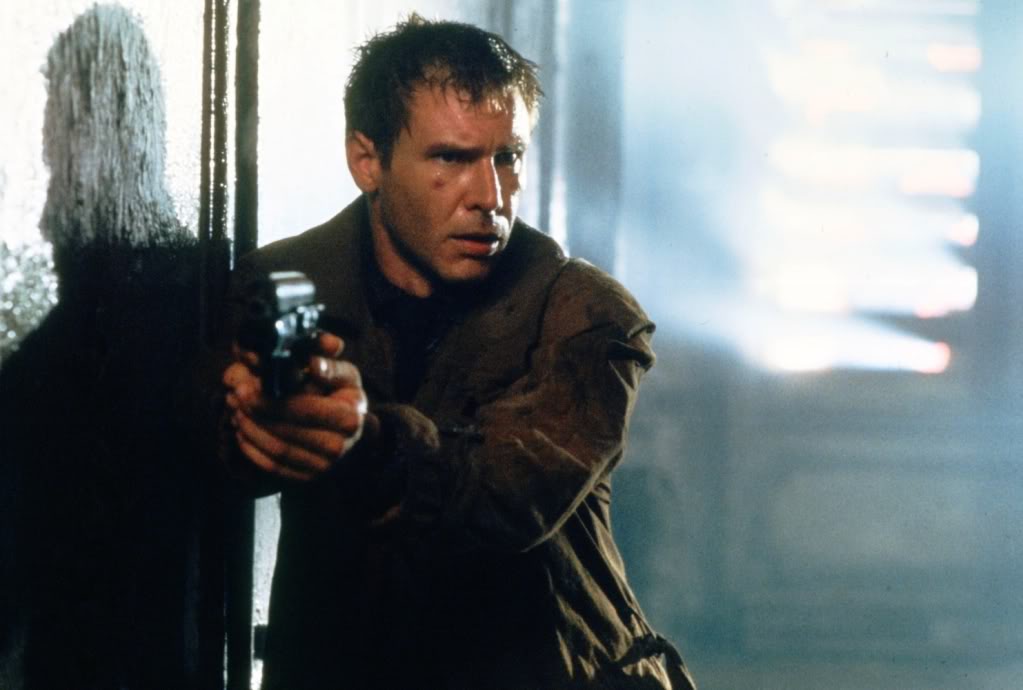
BLADE RUNNER (1982)

Why do soundtrack fans keep buying the same score repeatedly?  Admittedly, it's a question no one but friends and family of those fans might ask, however it can indeed become an odd quirk of the collector's habit.  Sometimes it's all due to a simple format change - LPs to cassettes, cassettes to CDs, digital downloads and somewhere in this evolution are 8-tracks.  It's not that far-fetched for the average music fan, since most everyone has upgraded at least one favorite album of theirs over the years, especially once our cars stopped being built with cassette decks.   However, it might be only on a soundtrack collector's shelves where a curious person finds two, three or even four copies of the same score, represented in multiple ways, all for various reasons that make total sense to the collector.  BLADE RUNNER became such a score for me.  

When growing up, I didn't have any "sci-fi" mentors - a peer, a cousin nor crazy uncle - to help me navigate that expansive world of books, TV shows and movies.  Since there was no internet available, I was left to my own devices to explore what was out there, often relying on magazines with a science-fiction slant for guidance, such as Starlog and Cinefantastique.  I spent hours at the bookstore, sitting cross-legged in the far back corner where the staff decided the genre should be sequestered, randomly sampling chapters from any number of books.  Each cover crowded with brilliant starbursts and gleaming rocket ships promised such excitement and unimagined adventures, I wished I could have read them all once.

And of course, there were new discoveries when simply perusing the soundtrack section at any record store.   Exotic titles such as LADYHAWKE and THE ROAD WARRIOR, movies I'd still not yet viewed, might alternately showcase either an immediate beloved score or perhaps instead a dull listen.  Great potential at higher financial risks - paperbacks were still cheaper than records.  But if a top ranked composer of mine scored a sci-fi or fantasy film, it was a sure bet I'd rent it or scan through TV Guide for any broadcasts.  Persuasive and intriguing mentions in a magazine was another method of nudging me to take a chance.  Into this mix appeared BLADE RUNNER.  It continued to appear in article after article, noted by some as an unheralded masterpiece and simply waiting to be appreciated during the ensuing years.  The director, Ridley Scott, had already provided me with persistent nightmares thanks to his previous film, ALIEN (1979).  The composer, Vangelis, however was new to me, as his biggest feature to date, 1981's CHARIOTS OF FIRE, failed to enter my spectrum of interest.  Nevertheless, I felt I had to see this film and hear its music.

BLADE RUNNER has been and always shall be a strange, entrancing and sometimes frustrating film.  Up until 1988 when I rented it on VHS, science fiction for me consisted of STAR WARS, STAR TREK, LOGAN'S RUN, BATTLESTAR GALACTICA and maybe THE BLACK HOLE.  Yet BLADE RUNNER presented me  with something set quite apart - an urban, downtrodden setting in the near future, a "film noir" story transplanted to the year 2019, inhabited by androids and colored by neon and flying cars.  An astoundingly immersive world was portrayed onscreen, stuffed with detail and such verisimilitude, all shrouded in hazy plumes of smoke.

The extreme violence and adult content jolted my developing sci-fi mind.  Nevertheless, the movie provided rich fodder for ruminations on big questions of immortality, the value of experience, the sadness of memory and whether androids crafted to emulate humans could ever be counted among humans.  Yes, my pensive, fifteen year old mind often pondered these questions.  My initial introduction was the infamous version sporting narration by star Harrison Ford, added late in production due to studio pressure.  I never really minded this narration.  It seemed to bolster ties to the "film noir" genre and its world-weary, hard-boiled gumshoes.  Oddly enough though, seeing the non-narrated version several years later resulted in diametrically opposing reactions.  Lacking the narration, the film becomes more inscrutable, leaving the viewer without a navigator through the myriad details of replicants, Voight Kampff tests and "gutter speak".   On the flip side, I found that there was new freedom to connect with characters other than the protagonist, detective Rick Deckard (Ford).


The music by Vangelis might have been the first all-electronic score that I fell for.  Strangely, it evoked the past in its dreamy, ethereal textures, but through a "future lens" of sorts by way of synth instruments.  And the sounds Vangelis crafted didn't simply attempt to emulate acoustic instruments, the electronics provided their own tonal mass which bathed the movie in a unique wash.  Synths sounds dominated many movie scores in the 1980's, but those from Vangelis couldn't quite be matched.  Now, picture if you will the disappointment faced by so many fans when we all separately, yet collectively, found that the original music from the film was not available anywhere.  What we all instead purchased on LP and cassette from our respective record shelves was a re-recording of the music performed by The New American Orchestra.  To clarify, orchestral movie music is most often my jam.  In this instance, though, any orchestra would be hard-pressed to reproduce a score with such sonic properties as BLADE RUNNER.  Additionally, a disco backbeat had been layered into several tracks.  Kitschy now, annoying then. 

For fans, it was all we had.  Over a decade passed before two original score tracks, the love theme and end credits, appeared on a compilation CD of Vangelis's various music projects.  Following this were several expensive, illegal bootlegs of mysterious origin that floated among collectors.  Then in 1994 news of an official release made waves and we all rushed to purchase this album as well.  What we were presented, though, was an amalgam of some original score cuts, often laced with dialogue from the movie, partnered with multiple "test tracks" composed by Vangelis back in 1982 which were never utilized.  It was alternately thrilling and frustrating.  There was still more music we wanted to own on disc and were denied.  Plus, if there's one item all soundtrack fans can agree on (and we can be a maddeningly fussy crew), it's that dialogue from the movie doesn't belong on the accompanying album.  If I want to hear the dialogue, I'll watch the movie.
So, by 1994, some fans had already owned three, if not four, copies of the BLADE RUNNER soundtrack, although the aforementioned Vangelis compilation includes many other excellent tracks.  Then, in 2007, another set was issued to celebrate the 25th anniversary and you can bet your Apple products that I sought this out on day one of its release.  I mean, come on, there had to be additional music from movie actually included this time, right?  Well, yes, finally more music was represented, but I began to perceive this endeavor as akin to a music cue scavenger hunt.  Or perhaps maybe it was a movie music jigsaw puzzle, where I had to collect the different album releases to piece together a somewhat complete picture of the score.  But so help me Jerry Goldsmith, I did just that.

Ironically enough, there's been as many versions of the actual film released as there are versions of the soundtrack.  From the 1982 original, studio-edited and narrated, to the International cut and both Director's and Final Cut editions, BLADE RUNNER unexpectedly kept evolving and morphing in the years since following its introduction to audiences.  I doubt anyone involved imagined one film with no sequels could generate and sustain such a level of interest.  For me, the production held as much mystery and interest as the fictional world displayed onscreen.  From the music angle, I wonder if the perennial screenings to mainly hear the score helped further endear the entire movie to me.

My viewings of BLADE RUNNER have diminished in recent years, whether due to changes in myself or changes in my life.   I'm still very fond of it, of course, but like many of my favorites I tend to make more time for the music than the movie.  What prompted me to essay my thoughts on this was that I randomly ran across a previously unknown French bootleg of the score.  I took a chance, bought it and ended up disappointed overall, as what I wound up with instead showcased terrible sound quality and content that matched what I already owned.  It could be that the habits of a soundtrack collector align with fervent Beatles or Grateful Dead fans, both groups seemingly seeking out all manner of early recordings, studio tracks, different mixes, often all of the same songs.

Mood is the essential to BLADE RUNNER, both the movie and its music.  It conjures up a unique, immersive mood that has yet to be duplicated elsewhere, even while elements of the film bled into the nooks and crannies of the cinematic science fiction genre during the ensuing years.   In terms of visual influence alone, it stands shoulder to shoulder with STAR WARS in affecting the entire genre.  It's interesting that its most powerful effect was primarily the look and feel of its world and that its story and character aspects didn't seem to resonate in such far-reaching terms. 

And as for Vangelis's score, it wound up being almost a singular accomplishment.  Maybe in some alternate universe, Vangelis has composed music for a string of sci-fi flicks, much as how John Williams, Jerry Goldsmith and James Horner followed up incredible initial entries with further trips into space-set sagas.  But alas, this was his only musical sojourn into the Fantastic and the what-if scenarios posed by futuristic films.  BLADE RUNNER can then be categorized under the "lightening-in-a-bottle" heading for all involved.  Yet with those multiple versions of the film now all available, each of us can choose to experience this "lightning" in presentations that suit our own mood and mindset.  Trouble is, how do I make time to watch any of those versions, when I have about five ways I can listen to the music too?