Tuesday, June 16, 2015

BLADE RUNNER (1982)

Why do soundtrack fans keep buying the same score repeatedly?  Admittedly, it's a question no one but friends and family of those fans might ask, however it can indeed become an odd quirk of the collector's habit.  Sometimes it's all due to a simple format change - LPs to cassettes, cassettes to CDs, digital downloads and somewhere in this evolution are 8-tracks.  It's not that far-fetched for the average music fan, since most everyone has upgraded at least one favorite album of theirs over the years, especially once our cars stopped being built with cassette decks.   However, it might be only on a soundtrack collector's shelves where a curious person finds two, three or even four copies of the same score, represented in multiple ways, all for various reasons that make total sense to the collector.  BLADE RUNNER became such a score for me.  

When growing up, I didn't have any "sci-fi" mentors - a peer, a cousin nor crazy uncle - to help me navigate that expansive world of books, TV shows and movies.  Since there was no internet available, I was left to my own devices to explore what was out there, often relying on magazines with a science-fiction slant for guidance, such as Starlog and Cinefantastique.  I spent hours at the bookstore, sitting cross-legged in the far back corner where the staff decided the genre should be sequestered, randomly sampling chapters from any number of books.  Each cover crowded with brilliant starbursts and gleaming rocket ships promised such excitement and unimagined adventures, I wished I could have read them all once.

And of course, there were new discoveries when simply perusing the soundtrack section at any record store.   Exotic titles such as LADYHAWKE and THE ROAD WARRIOR, movies I'd still not yet viewed, might alternately showcase either an immediate beloved score or perhaps instead a dull listen.  Great potential at higher financial risks - paperbacks were still cheaper than records.  But if a top ranked composer of mine scored a sci-fi or fantasy film, it was a sure bet I'd rent it or scan through TV Guide for any broadcasts.  Persuasive and intriguing mentions in a magazine was another method of nudging me to take a chance.  Into this mix appeared BLADE RUNNER.  It continued to appear in article after article, noted by some as an unheralded masterpiece and simply waiting to be appreciated during the ensuing years.  The director, Ridley Scott, had already provided me with persistent nightmares thanks to his previous film, ALIEN (1979).  The composer, Vangelis, however was new to me, as his biggest feature to date, 1981's CHARIOTS OF FIRE, failed to enter my spectrum of interest.  Nevertheless, I felt I had to see this film and hear its music.
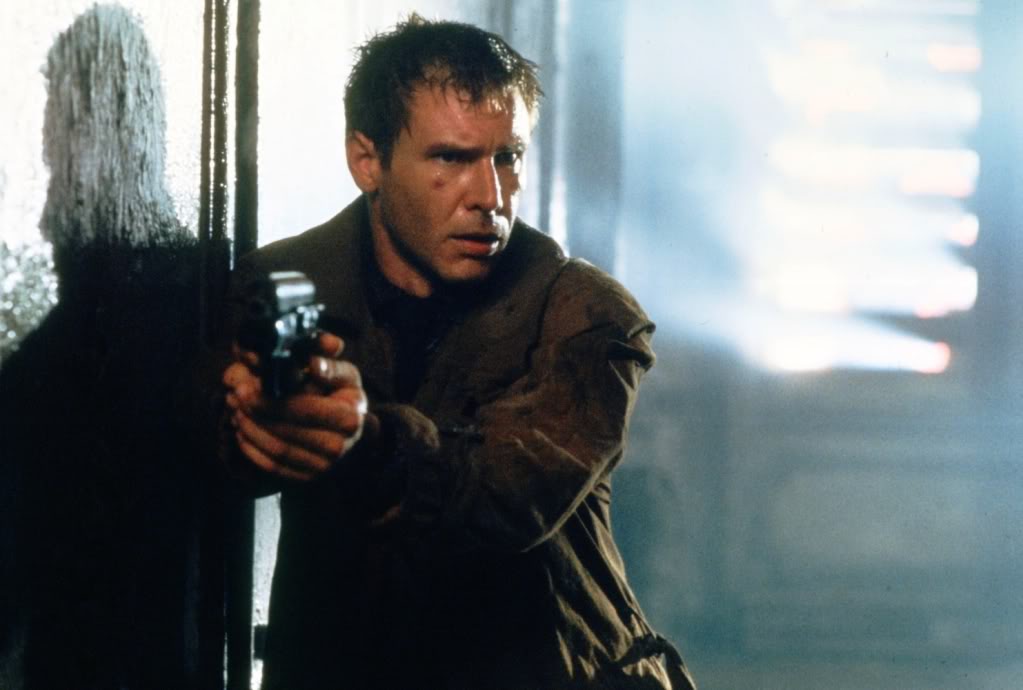
BLADE RUNNER has been and always shall be a strange, entrancing and sometimes frustrating film.  Up until 1988 when I rented it on VHS, science fiction for me consisted of STAR WARS, STAR TREK, LOGAN'S RUN, BATTLESTAR GALACTICA and maybe THE BLACK HOLE.  Yet BLADE RUNNER presented me  with something set quite apart - an urban, downtrodden setting in the near future, a "film noir" story transplanted to the year 2019, inhabited by androids and colored by neon and flying cars.  An astoundingly immersive world was portrayed onscreen, stuffed with detail and such verisimilitude, all shrouded in hazy plumes of smoke.

The extreme violence and adult content jolted my developing sci-fi mind.  Nevertheless, the movie provided rich fodder for ruminations on big questions of immortality, the value of experience, the sadness of memory and whether androids crafted to emulate humans could ever be counted among humans.  Yes, my pensive, fifteen year old mind often pondered these questions.  My initial introduction was the infamous version sporting narration by star Harrison Ford, added late in production due to studio pressure.  I never really minded this narration.  It seemed to bolster ties to the "film noir" genre and its world-weary, hard-boiled gumshoes.  Oddly enough though, seeing the non-narrated version several years later resulted in diametrically opposing reactions.  Lacking the narration, the film becomes more inscrutable, leaving the viewer without a navigator through the myriad details of replicants, Voight Kampff tests and "gutter speak".   On the flip side, I found that there was new freedom to connect with characters other than the protagonist, detective Rick Deckard (Ford).


The music by Vangelis might have been the first all-electronic score that I fell for.  Strangely, it evoked the past in its dreamy, ethereal textures, but through a "future lens" of sorts by way of synth instruments.  And the sounds Vangelis crafted didn't simply attempt to emulate acoustic instruments, the electronics provided their own tonal mass which bathed the movie in a unique wash.  Synths sounds dominated many movie scores in the 1980's, but those from Vangelis couldn't quite be matched.  Now, picture if you will the disappointment faced by so many fans when we all separately, yet collectively, found that the original music from the film was not available anywhere.  What we all instead purchased on LP and cassette from our respective record shelves was a re-recording of the music performed by The New American Orchestra.  To clarify, orchestral movie music is most often my jam.  In this instance, though, any orchestra would be hard-pressed to reproduce a score with such sonic properties as BLADE RUNNER.  Additionally, a disco backbeat had been layered into several tracks.  Kitschy now, annoying then. 

For fans, it was all we had.  Over a decade passed before two original score tracks, the love theme and end credits, appeared on a compilation CD of Vangelis's various music projects.  Following this were several expensive, illegal bootlegs of mysterious origin that floated among collectors.  Then in 1994 news of an official release made waves and we all rushed to purchase this album as well.  What we were presented, though, was an amalgam of some original score cuts, often laced with dialogue from the movie, partnered with multiple "test tracks" composed by Vangelis back in 1982 which were never utilized.  It was alternately thrilling and frustrating.  There was still more music we wanted to own on disc and were denied.  Plus, if there's one item all soundtrack fans can agree on (and we can be a maddeningly fussy crew), it's that dialogue from the movie doesn't belong on the accompanying album.  If I want to hear the dialogue, I'll watch the movie.
So, by 1994, some fans had already owned three, if not four, copies of the BLADE RUNNER soundtrack, although the aforementioned Vangelis compilation includes many other excellent tracks.  Then, in 2007, another set was issued to celebrate the 25th anniversary and you can bet your Apple products that I sought this out on day one of its release.  I mean, come on, there had to be additional music from movie actually included this time, right?  Well, yes, finally more music was represented, but I began to perceive this endeavor as akin to a music cue scavenger hunt.  Or perhaps maybe it was a movie music jigsaw puzzle, where I had to collect the different album releases to piece together a somewhat complete picture of the score.  But so help me Jerry Goldsmith, I did just that.

Ironically enough, there's been as many versions of the actual film released as there are versions of the soundtrack.  From the 1982 original, studio-edited and narrated, to the International cut and both Director's and Final Cut editions, BLADE RUNNER unexpectedly kept evolving and morphing in the years since following its introduction to audiences.  I doubt anyone involved imagined one film with no sequels could generate and sustain such a level of interest.  For me, the production held as much mystery and interest as the fictional world displayed onscreen.  From the music angle, I wonder if the perennial screenings to mainly hear the score helped further endear the entire movie to me.

My viewings of BLADE RUNNER have diminished in recent years, whether due to changes in myself or changes in my life.   I'm still very fond of it, of course, but like many of my favorites I tend to make more time for the music than the movie.  What prompted me to essay my thoughts on this was that I randomly ran across a previously unknown French bootleg of the score.  I took a chance, bought it and ended up disappointed overall, as what I wound up with instead showcased terrible sound quality and content that matched what I already owned.  It could be that the habits of a soundtrack collector align with fervent Beatles or Grateful Dead fans, both groups seemingly seeking out all manner of early recordings, studio tracks, different mixes, often all of the same songs.

Mood is the essential to BLADE RUNNER, both the movie and its music.  It conjures up a unique, immersive mood that has yet to be duplicated elsewhere, even while elements of the film bled into the nooks and crannies of the cinematic science fiction genre during the ensuing years.   In terms of visual influence alone, it stands shoulder to shoulder with STAR WARS in affecting the entire genre.  It's interesting that its most powerful effect was primarily the look and feel of its world and that its story and character aspects didn't seem to resonate in such far-reaching terms. 

And as for Vangelis's score, it wound up being almost a singular accomplishment.  Maybe in some alternate universe, Vangelis has composed music for a string of sci-fi flicks, much as how John Williams, Jerry Goldsmith and James Horner followed up incredible initial entries with further trips into space-set sagas.  But alas, this was his only musical sojourn into the Fantastic and the what-if scenarios posed by futuristic films.  BLADE RUNNER can then be categorized under the "lightening-in-a-bottle" heading for all involved.  Yet with those multiple versions of the film now all available, each of us can choose to experience this "lightning" in presentations that suit our own mood and mindset.  Trouble is, how do I make time to watch any of those versions, when I have about five ways I can listen to the music too?


Wednesday, April 22, 2015

GRAND BUDAPEST HOTEL (2014)

After listening to what seems like thousands of hours of film scores during the last thirty years and change, it now requires quite a unique feat of compositional acrobatics to gain my attention.   Perhaps it's due to my advancing age or the fact that, objectively, much of the music composed in film and TV these days just isn't intrinsically as interesting.  At some point during the last ten years or so, I crossed over into simply enjoying what I already have and discovered I wasn't as eager to invest in what was new.   Of course, I can't help but remain informed on the latest movie music, but I often hesitate to recruit many current composers or their scores into the ranks of my favorites.  That being said, 2014's GRAND BUDAPEST HOTEL and its composer, Alexandre Desplat, knocked me over with the power of a cimbalom and immediately bounded into my list. 

I'd wager that by my mid-30's, my core cast of treasured composers had settled into place.  Speaking musically yet in a comic book context, my super-heroic "Justice League" had solidified.  I had my Superman and Batman in the form of John Williams and Jerry Goldsmith, respectively.   Danny Elfman might be considered the hyperactive Flash, while Bernard Herrman exhibited the brooding, loner traits of the Martian Manhunter.  Filling out the ranks were John Barry, James Horner, Elmer Bernstein, Elliot Goldenthal, Shirley Walker, Ron Jones and Alan Silvestri.  Feel free to imagine which other superheroes they each could correspond to - for the life of me, I can't think of one that oozes as much sensuality as John Barry does in his music.  Maybe that's for the best, though.

These giants of their art all made their distinct impressions on me in the years prior, their music carved into my being.  I've never tired of their company.   New members could be added to the team periodically, however, such as when a discovered classic film and its score won me over or I simply took chances on unknown names seen on the record store shelves.  The key was to find myself affected greatly, connecting to a unique sound, style or approach.  For a long time, these fresh experiences were eagerly sought after, in the same manner as needing to meet and connect with new people.  Eventually, akin to aging classic rock fans who checked out of their genre around 1983, the modern styles soon felt strange and cold.  Yes, this can happen even to soundtrack fans.  Sometimes I wondered whether I should be worried about this change in me or instead just resume listening to every amazing score Jerry Goldsmith wrote in 1982.

 
I went into GRAND BUDAPEST HOTEL already a Wes Anderson fan.  Since 1998's RUSHMORE, I made it a point to catch all his movies, even if it wasn't always at the cinema.  His attention to detail appealed to me, how each of his movies appeared like finely crafted frescoes presented in ornately gift-wrapped packages.  The scenes and sequences were often staged in a mock proscenium style, lending a more traditional theatrical feel to the events and we the audience subconsciously might sense we're attending a live stage performance.  Yet interestingly enough, the actors deadpan much of their delivery and reactions, instead of leaning towards a grander, theatrical style to match their carefully curated surroundings.  This, plus the mercurial and mischievous nature of his work and the thoughtful choices in music, lend a unique quality to all of Anderson's movies, akin to the  consistent style and themes running throughout Steven Spielberg's or David Lynch's career.

Alexandre Desplat is a name I've been aware of for at least ten years.  I knew he was very talented and had been providing surprising, sophisticated scores to a variety of films, including two HARRY POTTER entries.  Admittedly, I hadn't seen many of his movies.  Additionally, I was less frequently taking stabs in the dark on current soundtracks without any foreknowledge.  As in the early days when I was a rookie, a cautious fan, it would require a cinematic bonding, where both the film and its score impressed themselves upon me at once.  Just like Stan Lee once mused that every comic book is someone's first, any particular work from a composer is some curious listener's introduction to their sound world.


GRAND BUDAPEST HOTEL eclipsed THE ROYAL TENENBAUMS as my top ranked Wes Anderson film.  I was held rapt by its characters, settings and structure, especially how it gently and subtly guides you backwards in time, from one storyteller to another, and then effortlessly circles around the block again to where you and the movie first met.  Certain sequences even left me a grinning, giddy fool, such as the snow mountain slalom escape and the unexpected gun melee.  Every line delivery by Ralph Fiennes is perfect.  That weirdly obscene erotic art used to replace the "Boy With Apple" painting still makes me chuckle.  And all during the adventures, Desplat's music uniquely colors every detailed corner of the film.  His idiosyncratic use of cimbalom and balalaika reminded me of 1960's Maurice Jarre film scores.  Meanwhile, the melodies themselves welcome you warmly yet seem noticeably tinged with melancholy, in concert with F. Murray Abraham's character, Zero.

I've since sought out more of Desplat's work, finding myself entranced by BIRTH, energized by THE MONUMENTS MEN and its jaunty, chin-up military march worthy of Elmer Bernstein's THE GREAT ESCAPE and awed by the sheer orchestral power displayed in his GODZILLA score.  There's a transparency and clarity in his music that I appreciate.  Too much current movie music sounds muddied and directionless, but I don't become lost or overwhelmed by Desplat's scores.  I trust he'll retain these qualities throughout subsequent projects.  His approach supplies needed fresh air to an aspect of cinema that can often be considered art and yet has recently dissolved into mere product.

Maybe in some way, the art of movie music can be considered kin to the legacy of the fictional Grand Budapest Hotel, in that there are far fewer stewards and patrons now who can care for the once lustrous and opulent establishment.  Its fading qualities are seldom appreciated or noticed except by those strange folk who seek it out, wishing to learn its secrets and history and wade through the overlooked treasures.  Or I'm possibly just allowing nostalgia and sentiment to stay far past checkout time.

Regardless, I'm happily including Desplat's music into my hours of listening, while simultaneously inducting him into my film score "Justice League".  Though I have no clue what superhero persona would fit an erudite French composer. 


Sunday, March 15, 2015

WILLOW / THE LAND BEFORE TIME / RED HEAT (1988)

I have a theory regarding ardent movie music fans and collectors, those deep in the folds, and that is the eventual habit of "buying blind".  Once your "listening wagon" is hitched to specific composers, purchasing soundtrack albums without having seen the movie or TV show it accompanies becomes the norm.  No different than an R.E.M. fan who picked up all of their records without first hearing a track.  I reached this stage in 1988 at fifteen years old.  Considering my meager earnings then, when the part-time jobs consisted of mowing lawns and teaching swim lessons to kids at the YMCA, these blind buys posed some risks.  I couldn't just grab every album that appeared intriguing.  I couldn't afford to see each new movie that featured music by a favorite composer.  Dollars earned versus dollars spent proved to be quite a balancing act.   And in that year, the motto of "two outta three ain't bad" applied to this early experience.

Initially for spending cash I solely relied on the small allowance from my dad,  which amounted to around four dollars every other week.   Of course, this can be a fairly typical scenario for teens both past and present, though I bet inflation has now adjusted that amount upward somewhat.    The result is muddling through the character building exercises of waiting and saving funds, possibly the financial equivalent of eating your vegetables at dinner.  At the age of fifteen, patience and pinching pennies could be akin to brussel sprouts. 

When Summer school break began in '88 this changed for me.  I started getting paid to mow lawns, both our own and the neighbors'.  In addition, I was hired at the local YMCA, where I competed on swim team, to teach swim lessons to kids under ten.  To be honest, my dad managed that YMCA, as he did in whichever town we lived, so I didn't face much of a rigorous interview process, due to being the boss' son.  The downside was that being the boss' son meant I couldn't really suck at the job and remain invisible.

Now, mowing lawns can be a strangely enjoyable Zen activity, sort of how I find washing dishes or vacuuming.  I put my gangly limbs to work and soon viewed the in-arguably successful results after a few hours.  However, the prospect of teaching small children to swim and survive in the water carried with it more pressure and expectation, not the least of which was keeping their tiny faces above the water.  I wasn't sure I could manage it.  Swim team competition bolstered confidence in my own aqua-abilities, but I was less positive about my ability to impart the necessary strokes to kindergarten kids.  Nevertheless, I accepted the job, aiming to justify my dad's assuredeness in me along with finally earning disposable income. 

So, I'd had my collecting eye on several recently released albums with the label "Music by James Horner" printed on their respective covers. Since being captivated by his music for STAR TREKs II and III and ALIENS, I decided to unquestioningly pick up whatever soundtracks featured his name (money willing, of course).  First up, I noticed his credit in small print on the posters for WILLOW, a movie set to be released that Summer.  It purported to be an epic fantasy adventure, starring the fresh-from-TOP-GUN Val Kilmer and written and produced by George Lucas.  Granted, I could've bouught a ticket to see the movie itself in the theater.  Instead my grass-fed and water-logged cash went to the soundtrack, on cassette no less.  My "listening wagon" had been securely hitched to Horner.  It was more important to hear new music from him, hopefully in the same vein as the aforementioned scores.


WILLOW emerged as an immediate favorite of mine, that opaque cassette looping its way repeatedly through my scuffed red Walkman, the notes tattooing themselves onto my musical memory.  It showcased a lilting choral element, heraldic brass themes and exciting, adventuresome set-pieces, everything I hoped for from a score in this genre.  Yes, I was left to imagine the matching onscreen action, gleaning details from pictures and articles in magazines, but it mattered little, the music was its own reward.  Months later, I actually received the movie on VHS as a birthday gift from my parents, an impressive feat when one considers how expensive first-run home videos were priced back then.  Trust me, it wasn't cheap.  And yeah, I kinda liked the movie too.  Kilmer ported over his smart-ass and smart-alack persona from REAL GENIUS and TOP GUN, flavored with a dose of swordplay.

The second Horner soundtrack blind buy was from the animated film called THE LAND BEFORE TIME, released in November that same year.  It was only his second animated feature, the first being 1986's AN AMERICAN TAIL, resulting in an Oscar nomination for the rising composer.  I'd seen this latter album on the record racks, but it looked to feature too many songs and not enough score, so I hesitated to purchase it.  However, THE LAND BEFORE TIME included only one song (by Diana Ross) listed among the tracks thus I felt secure I'd get my money's worth in a wealth of Horner's orchestral music.  Upon the initial listen, I decreed it another home run - a surprisingly expressive and powerful work, memorable and in the mold of Prokofiev's "Peter and The Wolf" concert ballet.  The man could do no wrong in my early estimation as a developing movie music fan.  But to this day, I still haven't seen this movie.

The third blind buy happened in December.  Unfortunately, I felt as if my listening wagon had struck a speed bump, a speed bump entitled RED HEAT.  I'm not sure what kind of score I expected for an action thriller starring Arnold Schwarzenegger and James Belushi, but a jazz/funk/synth fusion didn't occur to me in the slightest.  I could only shake my head confusedly as I heard music so diametrically opposed to WILLOW.  Only afterwards as I eventually worked backwards through Horner's career did I discover that this style emerged first in the films 48 HOURS, GORKY PARK and COMMANDO.  At that time, I couldn't see past large-scale orchestral compositions, my tastes and interest didn't allow for much beyond it.  I kicked myself for a failed blind buy, glumly realizing that not everything composed by James Horner hit my movie music sweet spot.

Yet it didn't diminish his star status for me.  Weirdly, I grew to love the moody RED HEAT and all its wailing sax solos, just not as much as those previous two '88 Horner scores.  Why place expectations that a new experience can only be good if it mirrors what's already happened?  RED HEAT never intended to be WILLOW, so why even compare the two.  Interestingly, WILLOW and THE LAND BEFORE TIME were later eclipsed once I was introduced to the James Horner magnum opus that is 1983's KRULL.  That one still ranks as my overall top favorite from his entire output, it's a god-damn powerhouse.  Anyway, appreciating the broad range of a film composer gained momentum here and I feel I owe a slow clap for the red-headed stepchild that is RED HEAT.  Soundtracks to movies yet unseen continued to stack up near my stereo, so obviously I was undeterred.

Regarding my time teaching swimming, after six weeks all the kids in my class successfully passed their final hurdle, jumping into the deep end wearing floaties and paddling out to me.  I recall not being able to visualize that last day on my first day.  I never thought I'd remember everyone's name, yet I did.  Each small stepping stone of just having them blow bubbles in the water or kick their legs really constructed a path to that deep-end achievement.  No step could be skipped, there was no rushing into eight feet of water for them.  As the kids garnered these skills I learned how to shepherd a group and methodically and patiently bestow knowledge I possessed.  Funny enough, my current job of training software to media buying agency groups can feel like teaching at a public pool populated with restless six year olds whom I have to corral.   Tell that to my fifteen year old self!


Saturday, January 24, 2015

BATMAN: THE ANIMATED SERIES

When it comes to favorite incarnations of the iconic comic book character Batman, the one presented in BATMAN: THE ANIMATED SERIES from the 1990's ranks at the top of my list.  Prior to this I had of course been exposed as a kid to the Adam West-led series from the 60's, along with Michael Keaton's portrayal in the 1989 feature film.  The latter kick-started my great admiration for the music of Danny Elfman, while the former motivated me to wear blue tights and tie a sheet around my neck... only when I was 8 years old, I swear.  Anyway, BATMAN: THE ANIMATED SERIES captured the interest of both me and my younger sister Meri in the Fall of 1992 and it's been my personal benchmark for the most compelling version of that fictional hero and his world.  It's also a show that's a special touchstone for me and Meri.  Lastly, and it wouldn't be my blog without mentioning this, the show features some of the best music composed for any TV series, live-action or animated.

This was during my sophomore year at Guilford College and I was back home for Christmas break.  I anticipated several indulgent weeks of junk food, TV and movies, Christmas shopping and decorations, plus time with the family.  For spending cash and peer socializing, I took some shifts at the Mexican restaurant I initially began working at periodically during high school.   I carried a particularly notable reputation as a stellar and fastidious busboy then, if I do say so myself, so I knew I'd be warmly welcomed back.  And I had the bolstered confidence of a second year college boy, meaning it was back to high school senior level and I might have been comfortable enough to ask a girl out.

In all honesty, though I'd found some great and weird friends at Guilford, I really missed hanging out with Meri.  We might have grown beyond recording our wacky home-made STAR TREK radio shows on cassette tapes, but we still clicked on everything, just as best friends should.  Even as I stepped into my 20's and Meri entered high school, our interests remained fairly synced (can't say I had any interest in the TV show "Blossom", however).  I try not to take for granted when I'm on the same page with someone, when there's no judgments or ridicule and the same things crack you both up.  I can't even begin to count how many times we watched GHOSTBUSTERS, BACK TO THE FUTURE and THE NAKED GUN on VHS and never tired of any of them.


So, I'd heard there was a new animated Batman series airing on Fox that Fall.  Meri and I were fans of the two Tim Burton-directed movies, especially the recent sequel from just that past Summer, and planned to catch the premiere episode once I was back home on break.  At college, the only program I was committed to watching was STAR TREK: THE NEXT GENERATION, thanks to my roommates tiny television, so this would be a new series for me.  On the music front, I was aware that Danny Elfman had provided an adaptation of his movie theme for this, while his conductor and orchestrator, Shirley Walker, composed the episodic scores. Appropriately enough, the introductory episode for us that December was titled "Christmas with the Joker". 

Immediately the show had us hooked.  We watched and recorded on VHS each episode that aired during that Christmas break, amazed at the quality from the stories to the animation.  Meri and I emerged as bigger fans of the Bat than we had been previously.  It could be due to the ongoing nature of a weekly series.  The characters and that universe more easily become a fixture in your daily life than as a two-hour movie.   Plus, there was such variety displayed by the show - moody, heartbreaking, witty and adventurous, you never really knew what experience to expect when you tuned in, but it was always engaging.  Thinking back now, I'm glad I shared this series with Meri as it aired.

Two aspects that most impressed me were the music and the voice talents. In terms of the class-act cast, Kevin Conroy, Mark Hamill and David Warner are the definite Batman, Joker and Ra's al Ghul for me now.  The orchestral scores, composed either by Ms. Walker or another of the talented members of her team, were sonorous, dynamic and memorable, always anchored by strong themes for Batman and his Rogues Gallery and colored by styles evoking dramatic music from the Golden Age of film.  An alert listener could discern elements of Danny Elfman's active brass writing alongside Bernard Herrmann's low woodwinds, harps and vibraphones and Franz Waxman's broad melodicism.   As with STAR TREK: THE NEXT GENERATION, I often revisited specific episodes on tape simply to hear the music, hoping one day some enterprising record label might release it all on disc. 

The following Christmas saw the theatrical release of BATMAN: MASK OF THE PHANTASM, a motion picture based on the animated series, from the same cast and crew.  Amazingly, it played for maybe one entire week nationwide.   Incredibly, Meri and I actually caught it at our quaint local theater in Rocky Mount, of all places.  It felt like 1986 and the animated TRANSFORMERS: THE MOVIE all over again.  Each time I revisit this movie, I smile at the fact that we saw it together on the big screen.  Those are memories I consider pretty special.  And to boot, the film is excellent.  Up until BATMAN BEGINS in 2005, MASK OF THE PHANTASM topped my list as the best of all the feature films based on the character.  And thank goodness there was finally a soundtrack album available that showcased Ms. Walker's music.  That disc spun around inside my CD player more often than most.

It wasn't until years later that I finally delved into the Batman comic books.  There's such a voluminous amount of over seven decades of his adventures in the printed format that a rookie can't understand where to begin.   I soon discovered that the 70's and 80's era was my jam, especially once I learned how stories and characters from these years influenced the animated series.  I was impressed at the wealth of material originating in the comic book that found its way into the show, yet not in a fashion that excluded the uninitiated. You didn't need to be schooled in the comics to enjoy the animated series.

When the topic turns to favorite long-running pop culture icons, we all have our individual entry points, akin to jumping onto a lengthy, moving freight train by way of the next open boxcar.  Part of us perfectly aligned with a specific presentation of that series or fictional figure.  It could be a case of "right time, right place", when our age at that moment allowed the icon to leave its imprint on us, just as initials carved in wet cement.  It could be due to the person we were then, whether more shy or more angry, that allowed us to bond with it.  Or perhaps a unique feature of the incarnation, maybe an idea or concept, an actor's performance or another artistic flourish, appealed to tastes we already favored.   I realize it's heady stuff to determine why we each like what we like, but I tend to ruminate on things of this nature.   STAR TREK: THE NEXT GENERATION fits the first category for me, the books of Clive Barker the second and Batman the third.  Neither the live-action show from the 60's nor Tim Burton's films converted me into a fervent fan, instead that distinction falls to the special melange of evocative music, colorful casting and bold animation presented in BATMAN: THE ANIMATED SERIES.

Please enjoy a suite of music from the series in the clip below, composed by Shirley Walker, and thanks to La-La Land Records for making this available on CD:


Monday, November 24, 2014

THE GHOST AND THE DARKNESS (1996)

With the immense diversity found in composer Jerry Goldsmith's music across his career as a film composer, it sometimes can be an entertaining game to guess how he might have scored the same film at a different time.  Often it's the genre pictures - science fiction, fantasy, action/adventure - that provide the most intriguing subjects and I think that 1996's THE GHOST AND THE DARKNESS fits the bill.   In listening to the album recently, I decided to devote a post to my thoughts on it.  While it's not in my top ten list of Jerry Goldsmith scores overall, I happen to consider it one of the highlights of his projects in the Nineties. 

The movie, directed by Stephen Hopkins, is based on a strange and harrowing event in 1898, when a construction engineer, named John Patterson, from the British Army is dispatched to East Africa to build a bridge across the Tsavo River in Kenya.  During the project, two lions terrorize the workforce, proving themselves man-eaters immediately.  The lions are named "The Ghost" and "The Darkness" by the locals.  Eventually, Patterson, played in the film by Val Kilmer, tracks and kills the two lions, however in the movie he is aided by a hunter originally from the States, played by Michael Douglas.  While the film itself may not be well-remembered or highly regarded, for sure the music is an element that warrants attention.  I wanted to examine this score in its proper filmic context but also look it in the context of Goldsmith's overall oeuvre.


Interestingly, Goldsmith's score orbits around three central ideas, which are often combined for maximum effect.  His main melody is broad and bold, voiced by brass in an English major mode, while rhythmic counterpoint is provided by a jaunty Irish motif on flutes.  The third element are sampled African voices, singing, calling and shouting, punctuating in both motivic and percussive gestures.  Essentially, the first two musical ideas represent Patterson, an Irishman working for the British East African Railway, his own persistence working in concert with the bullish confidence of 19th century Great Britain, all the while immersed in the striking and exotic wilds of East Africa.  In a way, it's comparable to Goldsmith's three-part musical summation of General George S. Patton in the 1970 hit PATTON.  There, he characterized the complicated and contradictory Patton through echoplexed trumpet triplets (representing his belief in reincarnation), organ chorale (representing his faith) and the famous march (representing his life in the military).  This approach to one individual seems to be expanded to summarize an entire movie's plot in THE GHOST AND THE DARKNESS.

Now, returning to play the game of how Goldsmith might have scored this movie at different points in his career, let's first travel back twenty years earlier.  Examining his projects in 1976, we find Goldsmith building to one of his most inspired periods, the late Seventies.  THE OMEN, THE WIND AND THE LION and LOGAN'S RUN are brilliant, unique works from this specific year, each one a highwater mark of its respective genre with long-lasting effects on subsequent scores. Had THE GHOST AND THE DARKNESS emerged as a project then, I imagine it would have more in common with those aforementioned scores, still being fully orchestral, perhaps bolstered by exotic percussion but with the harsh dissonance heard in much of his music of the era.  Outside of ALIEN in 1979, that dissonant quality eventually was supplanted by the Romanticism he explored later in the decade and the first half of the Eighties. 
 
By 1986, electronics had more fully entered his palate.  They had been a part of his music for quite some time, but beginning with UNDER FIRE in 1983 the synth element shifted more prominently to the forefront.  Goldsmith had even composed his first all-electronic score with RUNAWAY.  At this time, main themes, motifs and ostinatos were often carried by synthesizers instead of the orchestra, though his music was still just as complex and engaging.  Had THE GHOST AND THE DARKNESS been scored in '86, I think the attacking lions might have been characterized by odd electronic sounds, akin to what we heard in his music for GREMLINS and LEGEND, bolstered by the adventuresome orchestral quality of KING SOLOMONS MINES.  One could argue that with the story being a period piece set in the 19th century that only an acoustic score might fit, but in the 1980's Goldsmith still seemed fascinated with applying synths to any genre, as found in the medieval tale LIONHEART and the 50's era basketball drama HOOSIERS.

Suffice to say, that if the movie had indeed been produced twenty or even ten years earlier, it wouldn't have looked or sounded as it did in 1996.  Plus, Goldsmith wasn't one to provide the same sound for each film, even within the same genre or series, but I still find it interesting to wonder nonetheless, just going by his changing musical focus each year.  His growth as an artist all while still applying his talent and craft to movies over forty-five years make for a fascinating study, especially since his own voice is clear from the outset.

By 1996, after mainly steering clear from action/adventure films for several years, he was beginning a renaissance of sorts within the genre.   He had streamlined his sound.  The electronics were mostly dialed back to provide only color or pace as he composed for a more standard symphony orchestra arrangement.  He now showcased a preference for sweeping, major key themes, voiced broadly by strings and horns, perhaps awakened by his success with his music for RUDY in 1993 or just studios requesting further accessibility for general audiences.  Regardless, THE GHOST AND THE DARKNESS provided him an exciting and expansive canvas on which to musically paint with these new hues.

While some long-time fans of the composer felt unmoved by Goldsmith's scores of the Nineties, I happen to love a great deal of it.  This score in particular is an absolutely entertaining slice of his new predilections, combined with slices of his experimental side.  His thoughtfulness emerges in how he mixes the Irish, English and African musical idioms together, then pits them against the hollow, sometimes rattling sounds characterizing the lions.  Just as twenty years earlier, when music from that 1976 pointed to even greater examples closing out that decade, Goldsmith followed up THE GHOST AND DARKNESS with some marvelously engaging scores to cap off the Nineties.  THE EDGE, AIR FORCE ONE, LA CONFIDENTIAL, THE THIRTEENTH WARRIOR and THE MUMMY all display the best qualities of his then-current style with aspects of what was well-established for him.   In a funny way, this somewhat reflects the story of THE GHOST AND THE DARKNESS as well, in which modern bridges are built across well-traveled lands and new techniques combined with old wisdom prove potently successful.

In a neat twist of fate, when I moved to Chicago in 1998 and visited their renowned Field Museum, I was able to see the actual lions, which are on permanent display there.  Narration before the end credits mentions this fact, but at the time I had no clue that two years later I'd be see "The Ghost" and "The Darkness" up close and personal.